Guide
Commercial Ice Machine Problems: Symptoms, Checks, Fixes
Commercial ice machine problems in the order they appear, the safe checks kitchen staff can make, food-safety limits, and when to call for repair.
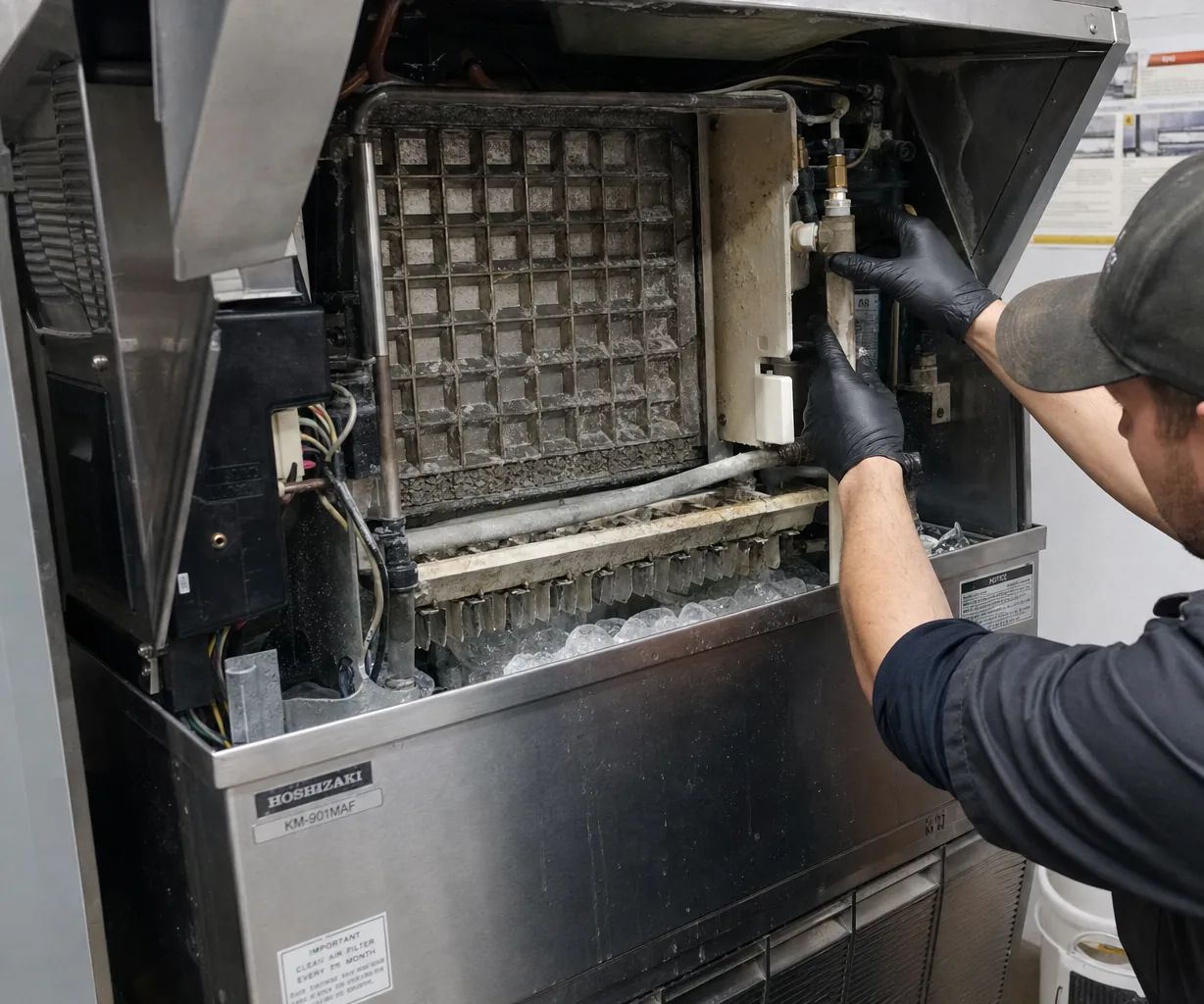
Most commercial ice machine problems trace back to 5 causes: mineral scale on the evaporator, a dirty condenser, a restricted water supply, a blocked bin control, or a failing refrigeration part. Staff can rule out the first 4 in about 15 minutes with the checks below; a machine that still runs without making ice after that needs a technician.
The failures also arrive in a predictable order: slow production and cloudy cubes first, then missed harvests, then a unit that freezes up, locks out or stops. Catching the early signs on a quiet Tuesday beats finding an empty bin at 7 p.m. on a Saturday.
What are the most common commercial ice machine problems?
| Symptom | Likely cause | Safe staff check |
|---|---|---|
| Bin fills slowly, thin cubes | Dirty condenser, hot room, low water flow | Clean the air filter, clear the vents, open the water valve fully |
| Cloudy or misshapen cubes | Scale, clogged water filter | Check the filter date; schedule a cleaning |
| Ice stuck on the evaporator | Scale, harvest or sensor fault | Note the error light; do not pry ice loose |
| Runs but makes no ice | Inlet valve, refrigerant leak, compressor | Confirm water reaches the trough |
| Off, lights on | Bin control blocked, safety lockout | Clear ice bridging the sensor; reset once |
| Water on the floor | Clogged drain, stuck float | Check the bin drain and floor-drain air gap |
| Off taste, odor or slime | Overdue sanitizing | Stop serving the ice |
What fails first, and what does each symptom mean?
Production loss is almost always first. Manufacturers such as Manitowoc and Hoshizaki publish output at 70°F air and 50°F water and again at 90°F air and 70°F water, and the hot-condition figure is noticeably lower. A machine wedged near the fryers, or with a condenser coated in grease and lint, behaves as if it is always at that hot rating. If a unit that kept up through dinner now runs short by 8 p.m., start with airflow.
Cube quality changes next. Minerals coat the evaporator and water distribution tubes, so water flows unevenly and cubes come out cloudy, hollow or half-formed. Left alone, that scale keeps ice from releasing at harvest.
That is the third stage. Most cube machines run a freeze cycle, then briefly warm the evaporator so the ice sheet drops into the bin. When it will not release, the machine builds a thicker slab and eventually shuts down on a safety lockout. Many units flash a light or code here; write it down before anyone resets the machine.
The last stage is a machine that hums but makes nothing, or does nothing at all. That points to an inlet valve, a failed sensor, a refrigerant leak or the compressor, none of which staff should open panels to chase.
What can kitchen staff safely check before calling?
Work through these 6 checks in order, without removing service panels:
- Power. Confirm the unit is plugged in and the breaker is on. If it trips again, leave it off and call.
- Water. Make sure the supply valve is fully open and the line is not kinked.
- Water filter. Check the cartridge date; most manufacturers suggest a change about every 6 months, sooner with hard water.
- Condenser airflow. On air-cooled units, wash the removable air filter and keep the clearance the manual specifies. Boxes against the vents choke output.
- Bin control. Ice bridging the bin sensor or curtain tells the machine the bin is full. Level it with a clean scoop and wait one cycle.
- Drain. Confirm the bin drain flows and the floor-drain air gap is clear.
Never chip ice off the evaporator with a knife or ice pick; a puncture turns a cleaning into a sealed-system repair. And use only the cleaner the manufacturer specifies, because the wrong acid can damage the evaporator surface.
How does a broken ice machine affect food safety and service?
Under the FDA Food Code, ice is food, so it must come from a clean machine or another approved source. If the bin shows slime, mold or black flecks, stop serving that ice, empty the bin, and buy bagged ice until the unit is cleaned and sanitized. Ice holding a raw bar or salad well must keep product at 41°F or below.
Downtime hurts elsewhere too: the bar loses drink sales first, and a kitchen that cools stocks or shocks vegetables in ice loses prep time. In Paramus, the blue laws close most retail stores on Sundays while restaurants stay open, so a machine that quits on Saturday night still faces a full Sunday service. Post a bagged-ice supplier’s number on the machine for that night.
When should you call for commercial ice machine repair?
Book commercial ice machine repair when the same error returns after one reset, the breaker trips twice, you see oil spots or hear hissing near the refrigeration lines, no water reaches the trough, the evaporator is frozen solid, or water keeps pooling on the floor. Call too if the compressor clicks on and off every few minutes; short cycling wears it out.
Before the visit, note the brand and model from the data plate, the symptom, any codes and the last cleaning date. For background on the equipment, see our commercial ice machine page. We are an independent service, not manufacturer-authorized.
What does commercial ice machine repair typically cost?
Typical ranges are $95–$165 for the diagnostic or service call and $350–$1,500 for ice machine repair, depending on the part and machine type. These are estimates; the firm quote is given on site after diagnosis. The full repair pricing list covers other equipment. To book, call (914) 350-6776.
Frequently asked questions
Why is my commercial ice machine running but not making ice?
The usual causes are a closed or failed water inlet valve, heavy scale on the evaporator, or a refrigeration problem. If the water supply is open, the filter is clear and still no ice forms, call a technician.
How often should a commercial ice machine be cleaned and sanitized?
Most manufacturers call for cleaning and sanitizing at least every 6 months. Kitchens with hard water, or with flour or yeast in the air, usually need it more often.
Can I reset my ice machine myself?
One reset after clearing an obvious cause, such as ice blocking the bin sensor, is reasonable. If the same code or shutdown returns, stop resetting and book a diagnosis, because repeated resets can leave the evaporator frozen solid.